Disability-Inclusive Climate Action
The Coalition for the Rights of Persons with Disabilities Activism (CRPDA) is proud to launch our pilot project on Disability-Inclusive Climate Action, a critical initiative aimed at ensuring that persons with disabilities are fully included in climate governance, disaster preparedness, and climate resilience efforts across Uganda.
This initiative is aligned with Sustainable Development Goal 13 (SDG 13): “Take urgent action to combat climate change and its impacts.” In particular, it responds to the global call to strengthen resilience and adaptive capacity to climate-related hazards and natural disasters for all people, especially the most vulnerable.
Climate change is not affecting everyone equally. It is having the greatest impact on the world’s poorest and most vulnerable communities, and among them are persons with disabilities who often face a double disadvantage. While they contribute the least to climate change, they are disproportionately affected by floods, landslides, droughts, heatwaves, and other climate-related disasters. Studies show that persons with disabilities can face mortality rates up to four times higher than their non-disabled peers during natural disasters.
For many persons with disabilities, climate change threatens access to food, water, shelter, healthcare, livelihoods, mobility, and personal security. Inaccessible evacuation systems, disrupted services, limited mobility, and exclusion from climate planning continue to increase their vulnerability and marginalization.
Imagine the experience of:
- A wheelchair user during severe flooding with inaccessible evacuation routes,
- A blind person navigating disaster zones without accessible information,
- A deaf person missing emergency warnings due to lack of sign language interpretation,
- Or a person with albinism exposed to extreme heat without adequate protection and support.
These realities underscore the urgent need for climate action that is inclusive, accessible, and rights-based.
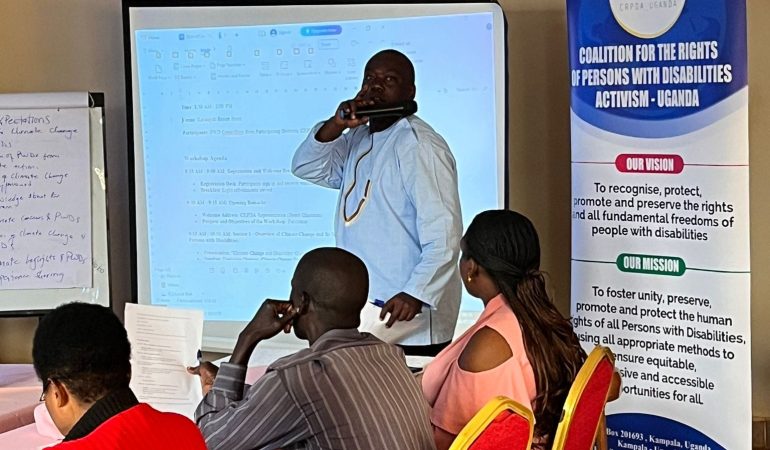
As part of this pilot project, CRPDA has brought together 16 District Councilors representing persons with disabilities from 8 districts in Eastern and Central Uganda that are highly affected by extreme weather conditions:
- Bududa
- Sironko
- Namisindwa
- Manafwa
- Kalangala
- Buvuma
- Buikwe
- Mpigi
These leaders are spearheading conversations within their respective district councils on how to mainstream disability inclusion in all climate action initiatives and local government programs. Through this engagement, we aim to strengthen local climate governance systems so that they respond to the needs and realities of persons with disabilities.
With support from the Youth Climate Justice Fund, this project is advancing advocacy for effective and inclusive climate governance by addressing:
- Institutional structures and coordination mechanisms,
- Laws, policies, and norms related to climate action,
- Government programs and budgeting processes,
- Stakeholder interactions and decision-making platforms,
- And the priorities set by Organizations of Persons with Disabilities (OPDs) and local government structures.
Our vision is clear: persons with disabilities must not be left behind in climate action. Their voices, experiences, strengths, and vulnerabilities must be represented in every climate forum, strategy, response mechanism, and policy discussion. Inclusive climate action is not charity — it is justice, equality, and effective governance.
At CRPDA, we believe that resilient communities can only be built when everyone is included. We therefore call upon government institutions, local authorities, civil society organizations, development partners, and communities to join us in promoting disability-inclusive climate action across Uganda.
Because climate justice is only possible when no one is left behind.